A crackling fire in the wood stove and fresh air from the ventilation system: many homeowners want both, but at the appointment with the chimney sweep an unfamiliar term often comes up. The air pressure monitor for a wood stove is designed to prevent extract devices in the house from creating negative pressure that draws flue gases from the stove into the living space. Without this safety device, the chimney sweep will in many cases refuse to approve the stove.
Right now, at the start of the heating season, when many stoves are lit again for the first time, the topic is worth a closer look. Here you will learn how an air pressure monitor works, on what basis the chimney sweep requires it, how they measure and when the monitor is not needed. We also compare the common solutions and show what matters for installation and testing.
What an air pressure monitor for a wood stove does
A room-air-dependent wood stove draws its combustion air from the room in which it is installed. For the flue gases to escape safely through the chimney, the draught in the chimney must be stronger than any negative pressure in the room. If a ventilation system, a range hood in extraction mode or a vented tumble dryer extracts more air from the house than can flow back in, this relationship can be reversed in unfavourable cases. Flue gases containing carbon monoxide then enter the home, a colourless and odourless gas that is dangerous even in low concentrations.
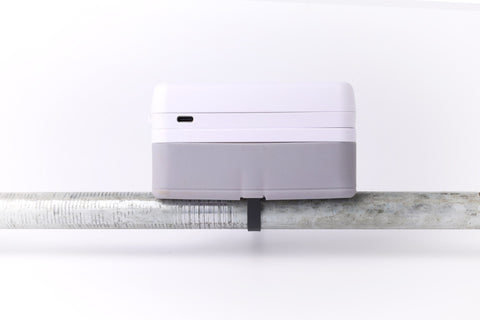
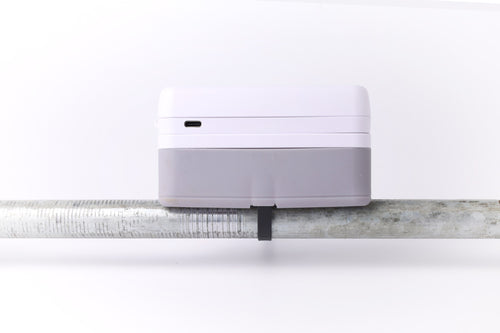
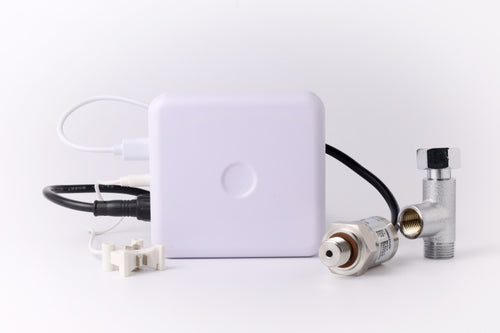
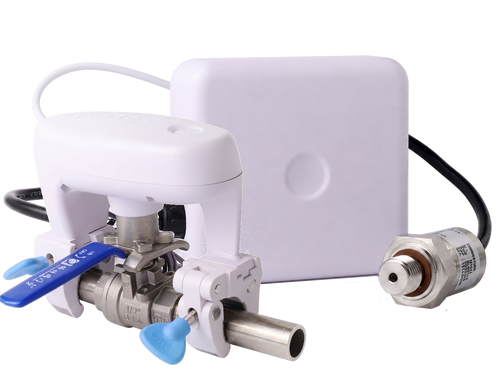
The air pressure monitor, often also called a negative pressure monitor or differential pressure switch, monitors exactly this situation. Using two measuring hoses, it compares the air pressure in the installation room with the pressure outdoors. If the negative pressure in the room rises above the permissible value, it disconnects the connected extract devices from the power supply. Only once the pressure has equalised again may they continue running.
When the chimney sweep requires an air pressure monitor
The basis is the combustion installations ordinance of the respective federal state, which is modelled on the German Model Combustion Ordinance (MFeuV). According to section 4 (2), room-air-dependent fireplaces may only be operated in rooms or flats from which fans extract air if one of several conditions is met: safety devices prevent simultaneous operation, the flue gas discharge is specially monitored, the flue gases are discharged via the extract system, or the system is designed so that no dangerous negative pressure can occur. The ordinance explicitly lists ventilation systems, warm air heating systems, range hoods and vented tumble dryers as such fans.
In practice, a negative pressure of no more than 4 pascals between the installation room and the outdoor air is regarded as the limit for room-air-dependent fireplaces. Whether you need an air pressure monitor in your case is decided by the authorised district chimney sweep during the approval inspection. The rules apply not only to wood stoves but by analogy to all room-air-dependent fireplaces, including older gas boilers without their own air supply. As of November 2026. As the combustion ordinances are a matter for the federal states, there may be regional differences.
How the chimney sweep checks the negative pressure
During the approval inspection, the chimney sweep usually switches all air-extracting devices to their highest setting and measures the differential pressure between the installation room and the outdoor air. In the trade this is known as the 4/8 pascal test: 4 pascals for room-air-dependent and 8 pascals for room-air-independent fireplaces. The safety device itself needs proof of suitability, such as a general building authority approval.
Which devices make an air pressure monitor necessary

With an air pressure monitor, many people only think of the ventilation system. In fact, the chimney sweep checks all devices that move air outdoors. Besides the comfort ventilation system, these include extract fans in bathrooms and toilets, the range hood in extraction mode, vented tumble dryers and central vacuum systems that exhaust outdoors. A powerful extraction range hood in particular can quickly build up considerable negative pressure in an airtight new building. The guide Range Hoods in Open-Plan Kitchens explains what matters during planning.
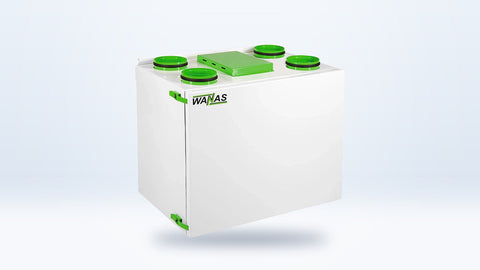
Ventilation systems with heat recovery do operate in a balanced way in normal mode, meaning they move roughly the same amount of supply and extract air. Special situations are critical, however: in frost protection mode, some units reduce the supply air while the extract air keeps running, and a clogged outdoor air filter reduces the supply air unnoticed. You can read how a preheater eases this problem in the guide Heating Coils in Ventilation.
When no air pressure monitor is needed
The air pressure monitor is usually not required for room-air-independent wood stoves with a general building authority approval from the German Institute for Building Technology (DIBt). These stoves draw their combustion air through a separate duct from outside and, according to the approval principles, must be airtight up to a negative pressure of 8 pascals in the installation room. The ventilation system must then not exceed this value. Range hoods in recirculation mode are also unproblematic, as they do not move any air outdoors. For an extraction hood, a window contact switch that only enables it when a window is open is sometimes sufficient.
Air pressure monitor, flue gas monitoring or window contact compared
Depending on the building and the combination of devices, different safety devices can be considered. All of them must be approved or type-tested for this purpose, and the chimney sweep must accept the chosen solution.
| Solution | How it works | Typical use |
|---|---|---|
| Air pressure monitor | Measures the differential pressure between the room and outdoors and switches off extract devices in the event of negative pressure | Ventilation system and range hood together with a room-air-dependent stove |
| Flue gas or fireplace monitoring | Detects via a temperature sensor on the flue pipe that the stove is burning and blocks the extract devices | When ventilation and stove should never run at the same time |
| Window contact switch | Only enables the range hood when a window is open | Extraction range hood without any other ventilation system |
| Room-air-independent stove | Draws combustion air from outside through an airtight duct | New building with controlled residential ventilation |
The air pressure monitor has one decisive advantage: it only intervenes when dangerous negative pressure actually occurs. Ventilation and stove can therefore usually run at the same time. Pure fireplace monitoring, on the other hand, switches off the ventilation whenever there is a fire, which in winter can mean hours without fresh air.
Installation, approval and testing of the air pressure monitor

Involve the district chimney sweep at the planning stage, not only after installation. They know the requirements in your federal state and will tell you which solution they will accept for your combination of stove and extract devices. The electrical connection is carried out by a qualified electrician. The air pressure monitor is usually installed in a flush-mounted box or as a plug-in adapter and switches the power supply to the ventilation system or the range hood.
The correct position of the measuring points is important. One hose ends in the room where the stove is installed, the other leads outdoors, often into a wind protection box on the façade. This prevents gusts of wind from distorting the measurement and causing constant false shutdowns. Make sure that the outdoor measuring point is not close to the exhaust air or outdoor air opening of the ventilation system.
Regular function testing
After installation, the chimney sweep checks the function and documents the approval. In everyday use, you should regularly test the shutdown using the test button. Some manufacturers recommend doing this monthly; the exact intervals are given in the operating instructions. Also check that the measuring hoses are clear and undamaged. If the monitor switches off frequently, the cause is often clogged supply air filters or extract air set too high. Our maintenance schedule for ventilation systems will help here. During the fireplace inspection, which takes place twice within seven years, the chimney sweep looks at the system again. As additional protection, experts recommend a carbon monoxide detector in the installation room, but it does not replace the air pressure monitor.
Frequently asked questions
Do I need an air pressure monitor if I only have a range hood?
That depends on the operating mode. Under the combustion ordinance, an extraction hood counts as an air-extracting system. The chimney sweep will then usually require an air pressure monitor or a window contact switch. A recirculation hood does not need such a safeguard.
Is a room-air-independent wood stove without DIBt approval sufficient?
No. Under the approval principles, a stove only counts as room-air-independent if it has a general building authority approval from the DIBt. An external air connection alone is not enough; the chimney sweep will then treat the stove as room-air-dependent.
Can I install the air pressure monitor myself?
Laying the measuring hoses is manageable for a skilled DIYer, but the electrical connection belongs in the hands of a qualified electrician. In addition, the chimney sweep has to approve the installation. You should therefore agree on the device and installation location with them beforehand.
Does an air pressure monitor also work with decentralised ventilation?
Yes, there are models for decentralised ventilation units. Units with heat recovery that operate in pairs create hardly any negative pressure in normal mode, whereas pure extract fans do.
Conclusion
An air pressure monitor for a wood stove is not red tape; it protects you from flue gases and carbon monoxide in the living space. The chimney sweep requires it on the basis of the combustion ordinance when a room-air-dependent stove and air-extracting devices come together. With room-air-independent stoves with DIBt approval or recirculation hoods, it is often not needed. If you plan with the chimney sweep at an early stage, you avoid expensive retrofits and can later run your stove and ventilation comfortably side by side. You will find suitable pressure monitors and accessories in our Erich Huber category, and extraction and recirculation hoods under Kitchen Extraction and Range Hoods.