

Blauberg Ventilatoren GmbH
Blauberg VENTO Expert Spare Parts
● Available
from 11,50 €incl. VAT
Choose options
Here you will find decentralized ventilation units with heat recovery for individual rooms and central ventilation units for the whole home, including models from Blauberg, S&P, Nilan and DUCO. Decentralized units are installed directly in the external wall and need no ductwork, while central units supply every room through ventilation ducts. The guide below explains what to consider when choosing, planning, installing and maintaining a system.
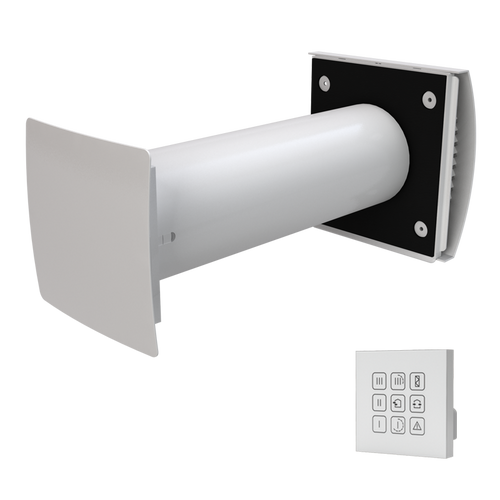
A decentralized ventilation system consists of individual units, each fitted in an external wall and supplying one room with outdoor air. Unlike central residential ventilation, no ductwork is needed. Each unit contains a fan, a heat exchanger or heat accumulator and a filter, and an outer hood protects it against rain and insects. Depending on the model, the units are operated via a control panel, a remote control or an app. Many models have a humidity sensor that raises the fan speed when humidity is high.
For a detailed comparison of systems including costs and funding, see our guide Central vs. decentralized ventilation.
Push-pull units work with a fan that reverses its direction and a ceramic heat accumulator. First the unit moves warm room air outside and charges the accumulator. Then it reverses direction, and the incoming outdoor air picks up the stored heat. According to the manufacturer, the Blauberg VENTO inHome S11 changes direction every 70 seconds. Push-pull units are operated in pairs: while one unit extracts air, the second supplies outdoor air, and then they swap roles.
Units with a counterflow heat exchanger move supply air and extract air at the same time through separate air paths. In the heat exchanger, heat passes from the extract air to the supply air without the air flows mixing. Such a unit balances the air exchange of a room on its own and needs no partner unit. Examples are the wall-mounted units of the Blauberg Freshbox series with an enthalpy counterflow heat exchanger. The Blauberg Freshpoint 160-E Pro also supplies and extracts air simultaneously with two fans, in this case via a copper heat exchanger, and needs only one core hole.
Manufacturers state how much heat a unit recovers as its heat recovery efficiency. Blauberg specifies a maximum of 93% for the VENTO Expert A50-1, a maximum of 95% for the VENTO inHome S11 and 88% for the Freshpoint 160-E. These are peak values. The ecodesign value at the reference airflow is 74% for the VENTO inHome S11. Always compare units using the same figure. Learn more in our guide Heat recovery explained. Whether moisture recovery is also worthwhile is covered in our article on the enthalpy exchanger.
In existing buildings, decentralized ventilation is often the obvious solution: each unit needs only one wall opening and a power supply, ceilings and floors remain untouched, and you can proceed room by room. This is particularly relevant after replacing windows or insulating the facade, when the building has become more airtight. Our guide Retrofitting decentralized ventilation shows how the installation works.
In new builds, both systems are possible. According to Blauberg, the VENTO units are suitable for new builds as well as for retrofitting. If ducts can be planned into ceilings and walls anyway, it is worth comparing with a central system. Decentralized units remain attractive when individual rooms are to be controlled separately or there is no space for a central unit and ducts.
The starting point is the air requirement of each room. As a rough guide, multiply the room volume by the air change rate or allow about 30 m³/h per person present; our guide Calculate airflow rate shows the calculation. Compare this requirement with the airflow of the units in heat recovery mode, not with the maximum value in pure ventilation mode. According to the manufacturer, the VENTO Expert A50-1 W V.2 delivers up to 25 m³/h in heat recovery mode and up to 50 m³/h in ventilation mode without changing direction.
Each wall unit requires a core hole through the external wall. For units with a 160 mm pipe, such as the VENTO inHome S11 or the Freshpoint 160-E Pro, the hole must be slightly larger than the pipe; the exact size is given in the installation instructions. The hole is drilled with a slight downward slope to the outside so that condensate can drain. Check the permitted wall thickness in advance: according to the manufacturer, the VENTO inHome S11 complete set is designed for walls from 255 to 490 mm, the Freshpoint 160-E for 245 to 440 mm. For thicker walls, check before buying whether a longer pipe is available for the unit.
For load-bearing walls, facing brickwork, external thermal insulation composite systems or walls with cables and pipes, the drilling should be done by a specialist contractor, and the electrical connection also belongs in professional hands. Accessories such as the VENTO inHome drilling template, inner covers and spare parts can be found under Accessories and spare parts.
Decentralized units sit directly in the room, so the sound pressure level is an important selection criterion. Only compare values measured at the same distance. According to Blauberg, the VENTO Expert A50-1 Pro reaches 11 to 21 dB(A) at a distance of 3 m depending on the speed, the VENTO inHome S11 11 to 27 dB(A) and the VENTO Expert DUO A30-1 W V.2 24 to 34 dB(A). For the Freshpoint 160-E, the manufacturer states 42 dB(A) at 3 m.
In bedrooms, plan so that the low speed is sufficient for night operation, and do not place the unit directly next to the head of the bed. On busy streets, it is also worth checking the data sheet for the sound insulation against outdoor noise.
The Blauberg VENTO Expert, VENTO inHome and Freshpoint units are fitted with a G3 filter as standard, a coarse dust class under ISO 16890 (ISO Coarse). It protects the heat exchanger and fan against dust and insects. For allergy sufferers, finer filters are available depending on the unit: for the VENTO inHome S11, Blauberg lists G4 (ISO Coarse above 60%) and F7 (ISO ePM1 60%) as options, and for the VENTO Expert A50 there is the FP2 Vento F7 filter with holder. Finer filters retain more pollen and fine dust but increase air resistance.
Check the filters roughly every three to six months depending on the load, and clean or replace them as specified by the manufacturer. Replacements such as the VENTO Expert filter set can be found in the Air filters category. Our guide Filter classes for ventilation systems explains the filter classes, and the ventilation system maintenance plan lists the intervals for all components.
A central ventilation system supplies the whole home from one unit. Supply air flows through ducts into living rooms and bedrooms, and extract air is drawn from the kitchen, bathroom and WC. Filter changes and maintenance take place in one location, and the unit is located outside the living areas. In return, space is needed for the unit and ducts, which is often complex in existing buildings. In this category you will find central units from Nilan, DUCO, Blauberg and S&P, among others, and ducts and fittings under Ventilation ducts and fittings.
| Criterion | Decentralized ventilation | Central ventilation |
|---|---|---|
| Air distribution | Units in the external wall, no ducts | One unit, ducts to all rooms |
| Installation in existing buildings | Room by room with core drilling | Ducts in ceilings or walls required |
| Maintenance | Filter in each unit | Filter in the central unit |
| Noise | Unit in the room, audible depending on speed | Unit outside the living areas |
| Control | Per room or pair of units | Central for the whole home |
DIN 1946-6 governs the ventilation of dwellings. According to the standard, a ventilation concept must be prepared for new builds and for modernisations if more than one third of the windows are replaced in an apartment building, or if more than one third of the windows are replaced or more than one third of the roof area is resealed in a single-family house. The concept checks whether ventilation for moisture protection is ensured without any action by the occupants, that is, even without opening windows. The standard distinguishes four levels: ventilation for moisture protection, reduced ventilation, nominal ventilation and intensive ventilation.
Whether and how many decentralized units achieve the required airflows follows from this concept. Have it prepared by a qualified person, such as an energy consultant or a ventilation planner. Details can be found in our guide Ventilation concept according to DIN 1946-6.
Push-pull units always work in pairs, and one unit per living room, bedroom or children's room is usual. The exact number depends on the airflow specified by the ventilation concept and on the airflow of the units in heat recovery mode.
Many residents fit the inner unit and change the filters themselves. The core hole through the external wall and the electrical connection should be done by a specialist contractor, especially for load-bearing walls.
That depends on the unit and the speed. For the VENTO Expert A50-1, Blauberg states 11 dB(A) at the lowest and 21 dB(A) at the highest speed at a distance of 3 m. When comparing, make sure the measuring distance is the same.
Check the filters roughly every three to six months depending on the dust and pollen load, and clean or replace them as specified by the manufacturer. Dirty filters reduce the airflow.
In heat recovery mode, a push-pull unit regularly reverses direction and recovers heat. In ventilation mode it runs without changing direction and, depending on the setting, supplies or extracts air only, for example when no heat recovery is wanted in summer.
The heat exchanger preheats the outdoor air before it enters the room. At very low outdoor temperatures, however, the supply air is still cooler than the room air. Some units, such as the Freshpoint 160-E Pro, therefore have a heating element that can be switched on, rated at 100 W according to the manufacturer.
In a rented apartment you need the landlord's consent, ideally in writing. In an owner-occupied apartment the external wall usually belongs to the common property, in which case a resolution of the owners' association is required. For listed buildings, check with the heritage protection authority beforehand.


Selected products from ventilation, filter and pipe technology.


