Retrofitting Decentralized Ventilation: Step-by-Step Installation

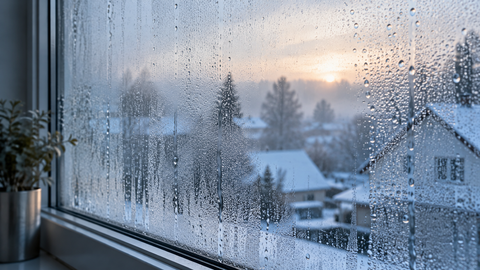
Humid, stale air, fogged-up windows and, in the worst case, mold in the corners of rooms: well-insulated older buildings and freshly renovated apartments often lack natural air exchange. If you cannot or do not want to air out intensively several times a day, having decentralized ventilation retrofitted is one of the most effective measures. Unlike a central system, it does not require an elaborate duct network and can be installed room by room, even in occupied existing buildings.
In this guide, you will learn when retrofitting is worthwhile, how decentralized units with heat recovery work and how installation with core drilling proceeds step by step. We also show you realistic costs and the current status of funding in 2026 so that you can plan your project confidently from the start.
When decentralized ventilation can be retrofitted
In principle, almost any room with an accessible exterior wall can be retrofitted. Since no duct network has to be installed, the intervention in the building fabric is minimal, a key advantage over a central system. Retrofitting makes particular sense where a lot of moisture is generated or where people spend long periods of time: in bedrooms, living rooms, children's rooms and the bathroom. If you are still unsure which system suits your property, our comparison central vs. decentralized ventilation will help you decide.
It is important to consider the ventilation concept according to DIN 1946-6. If a large proportion of the windows were replaced or the roof was newly insulated during a renovation, proof of adequate ventilation is often mandatory because the building is significantly more airtight afterwards. Planned ventilation replaces unreliable manual airing and provides lasting protection against moisture damage. You will find suitable units and accessories in our range of decentralized ventilation units.
How decentralized ventilation with heat recovery works
The heart of modern units is a ceramic heat accumulator. When warm room air is extracted, the accumulator absorbs its heat. After a short time, the fan reverses direction and draws in cool outdoor air, which is preheated again in the accumulator. In this way, good units recover around 80 to 84 percent of the heat on average, with peak values of about 90 percent. This noticeably lowers heating costs and prevents cold drafts.
To keep supply air and exhaust air balanced, the units are usually operated in pairs. While one unit moves air outward (push), the second draws fresh air in (pull). Both switch over together every 60 to 90 seconds. This creates a constant, gentle air exchange throughout the entire apartment. An integrated filter retains dust and pollen. You can read how heat recovery works on a larger scale in our guide to controlled residential ventilation.
Retrofitting decentralized ventilation: step-by-step installation
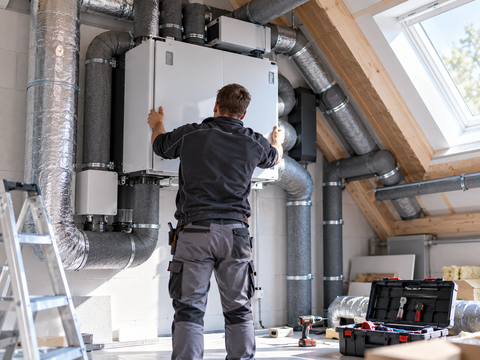
A decentralized unit can be installed in one day. The following steps show the typical process per room:
- Planning and unit selection: Define the rooms, determine the airflow rate based on room size and distribute the units sensibly across opposite rooms so that push-pull operation works.
- Core drilling: A hole of typically 100 to 160 millimeters is drilled through the exterior wall, with a slight downward slope toward the outside so that condensate can drain away safely.
- Inserting the wall sleeve: The wall installation pipe is pushed in, cut to length and carefully sealed all around to prevent a thermal bridge. We carry suitable ducts and fittings under ventilation ducts and fittings.
- Mounting the weather hood: On the outside, the hood with insect and rain protection is installed so that neither moisture nor small animals can get in.
- Fitting the interior unit: Inside, the heat accumulator, fan and filter are inserted and the interior cover is attached.
- Electrical connection and controls: The unit is connected to an existing electrical circuit and linked to the central controller or the wireless controller.
- Commissioning: Finally, the fan speeds are set and the pairs are adjusted so that supply air and exhaust air are balanced.
A note on safety: if the wall is load-bearing or exposed masonry, the core drilling should be carried out by a specialist contractor. The electrical connection also belongs in professional hands. The units themselves can then usually be fitted without complications.
Costs and funding in 2026
Costs depend mainly on the number of rooms and the wall construction. The following overview gives you realistic guide values:
| Item | Cost (guide value) |
|---|---|
| Single unit with heat recovery (material) | 300 to 800 € |
| Core drilling per opening | 100 to 300 € |
| Fully installed per room | 500 to 1,500 € |
| Single-family home with around 6 rooms | 3,000 to 8,000 € |
Retrofitting is also eligible for funding. Under the German Federal Funding for Efficient Buildings (BEG), an individual measure currently qualifies for a grant of 15 percent of the eligible costs, or up to 20 percent with an individual renovation roadmap (iSFP bonus). Costs of up to 30,000 euros per residential unit are eligible. Requirements include a heat recovery efficiency of at least 75 percent. Very important: the application must be submitted before the measure begins; retroactive funding is not possible. Check the exact conditions with BAFA (Federal Office for Economic Affairs and Export Control) before you start.
What to look for in units and maintenance
When buying, it is worth looking at the heat recovery efficiency, the sound insulation (especially in the bedroom) and the filter class. For allergy sufferers, units with fine particulate or pollen filters are recommended. A controller with a humidity or CO2 sensor adjusts the output automatically and saves electricity.
Like any ventilation system, the decentralized version needs a little care. Depending on the load, the filters should be cleaned or replaced every three to six months; you will find suitable replacements under bag and compact filters. Our maintenance schedule for ventilation systems provides a clear summary of when each component is due.
Frequently asked questions
Can I retrofit decentralized ventilation myself?
Fitting the interior unit and changing the filters can usually be done without specialist knowledge. The core drilling through the exterior wall and the electrical connection, however, should be carried out by a specialist contractor, especially for load-bearing walls.
How many units do I need?
For heat recovery in alternating operation, at least two units working in opposite directions are required. In practice, a rough rule is one unit per room to be ventilated, distributed across opposite rooms.
Is decentralized ventilation drafty or cold in winter?
No. The ceramic heat accumulator preheats the incoming outdoor air so that no cold drafts occur. Most of the room heat stays in the house.
Am I allowed to retrofit in a rented apartment?
Since a hole is drilled into the exterior wall, the landlord's written consent is required. Discuss the project in advance and put the agreement in writing.
Conclusion
Retrofitting decentralized ventilation is one of the most effective ways to ensure permanently fresh, dry air in existing buildings and to prevent mold. Since no duct network is needed, the effort remains manageable and installation is possible room by room, even while the home is occupied. Heat recovery also lowers heating costs, and part of the investment can be recouped through the BEG. Look for a high heat recovery efficiency, good sound insulation and regular filter maintenance, and the system will reliably deliver good air for many years. You will find suitable units, ducts and filters for your project in our ventilation range.