How much water does your home really use, and is water leaking away somewhere unnoticed? The main water meter only gives a rough answer: it usually sits in the basement, is read once a year and shows neither daily values nor a dripping tap. If you want to measure water consumption without opening the pipe, you can now clamp an ultrasonic sensor onto the outside of the pipe. There is no pipe cutting, no water shut-off and no change to the installation.
In this guide we explain how measuring through the pipe wall works, which pipes it is suitable for, what to consider during installation and which solution fits copper pipes or automatic shut-off in case of a leak. All technical data comes from the manufacturer Aqua-Scope.
How measuring without touching the pipe works
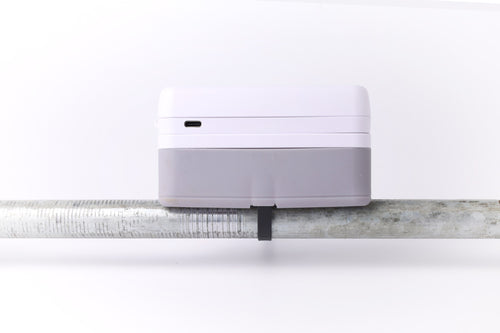
The Aqua-Scope Sonic Clamp uses the ultrasonic transit time method (time of flight) at 1 MHz. Two ultrasonic transducers send signals through the water, once with and once against the direction of flow. When water flows, the signal travelling with the flow is slightly faster than the one travelling against it. The device calculates the flow rate from this difference and also records the water temperature.
Because the sensors sit on the outside of the pipe, the device never comes into contact with the drinking water. The water supply keeps running during installation and the pipe remains unchanged. Removing it later is just as easy as fitting it.
Which pipes the ultrasonic clamp is suitable for
The pipe material is decisive for reliable measurement. According to the manufacturer, the Sonic Clamp is intended for plastic pipes:
- PEX, PEX AL (multilayer composite pipe), PP and PE
- outside diameter 16 to 50 mm
- a straight, clean section of pipe at least 20 cm away from bends and fittings
- sensor on the side of the pipe, not on sloping sections
On copper and other metal pipes, installation is difficult according to the manufacturer and the measurement may be unreliable. The manual also mentions plastic-coated soft copper, but we only recommend the clamp for plastic pipes. For homes with copper pipes there is another solution, described below.
Installation in a few steps
According to the manufacturer, the package contains the sensor unit, a spacer set for common pipe diameters, contact pads with spare pads, fine sandpaper, ultrasonic coupling gel, cable ties and the user manual. The process roughly looks like this, the manual describes the details:
- Choose the measuring point: a straight piece of plastic pipe with enough distance to bends, tees and valves, for example directly after the main water meter.
- Prepare the pipe: clean the contact area and smooth it with the enclosed sandpaper if necessary.
- Fit the clamp: choose the right spacer for the pipe diameter, apply contact pads and coupling gel, align the sensor on the side of the pipe and secure it with cable ties.
- Connect power: via USB-C (5 V / 2 A) or two AA batteries. In mains operation, inserted batteries serve as backup. Batteries are not included, and the manufacturer does not list a power supply in the scope of delivery.
- Set up: the Wi-Fi version is connected via the Aqua-Scope app (iOS and Android), the manufacturer provides instructions at docs.aqua-scope.com.
No plumber is needed for these steps because the drinking water installation is not touched. If you are unsure about the measuring point, we are happy to advise you by phone or email.
What the measurement shows
From the measured flow, the device detects more than just total consumption:
- Consumption over time: you see when and how much water is used.
- Drip losses: detection from about 0.1 l/min, depending on calibration.
- Continuous consumption: such as a tap left open or a constantly running toilet.
- Burst pipe: flow above 30 l/min, the threshold is adjustable.
- Temperature of the water at the measuring point.
A simple calculation shows how much a small leak adds up to: 0.1 litres per minute means 144 litres per day and around 52,500 litres per year. Such losses are hardly noticeable in everyday life, but they are visible in the measured values. Consumption data and alarms are also useful for holiday homes, rented units or buildings that are empty at times.
Wi-Fi or LoRaWAN?
The Sonic Clamp is available in two radio versions:
| Version | Transmission | Requirement |
|---|---|---|
| Wi-Fi | Wi-Fi 2.4 GHz, Aqua-Scope app, MQTT, JSON webhook | 2.4 GHz Wi-Fi at the installation site |
| LoRaWAN | LoRaWAN EU868, Class A | LoRaWAN coverage or your own gateway |
Via MQTT or webhook, data from the Wi-Fi version can be integrated into smart home systems such as Home Assistant. The LoRaWAN version is mainly suited to places where a LoRaWAN infrastructure already exists, for example in residential property management.
Copper pipes in the house: Leak Protection Monitor Plus
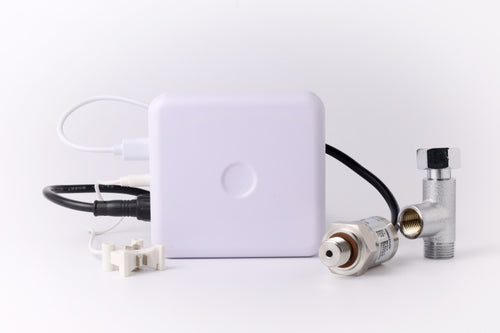
If the house has copper or stainless steel pipes, the Aqua-Scope Leak Protection Monitor is the right choice. It does not measure through the pipe wall but via a sensor head with a G1/4 connection, which is screwed into an inspection opening or mounted on the angle valve under a washbasin with the supplied tee. The monitor checks water pressure (0 to 10 bar) and temperature several times per second and reports overpressure or underpressure, burst pipes and water at the cable flood sensor.
The Monitor Plus version (Wi-Fi) also measures water consumption with hourly and daily values in the app. According to the manufacturer, the sensor head must be installed after any pressure reducer.
Shutting off the water automatically in case of a leak
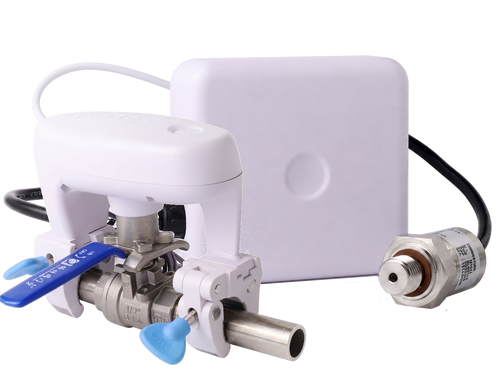
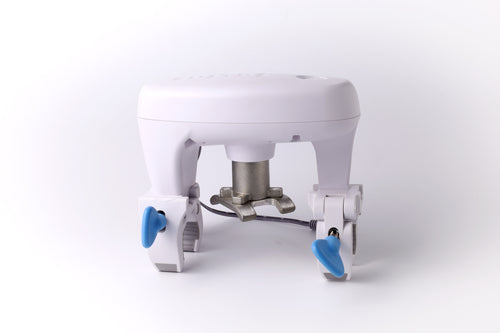
Measuring alone does not prevent damage. If you want to react to a burst pipe even when you are away, combine the monitor with a retrofit motor. The Water Guard for ball valves is placed on an existing lever ball valve (DN15 to DN32) and fixed to the pipe with a clamp, without dismantling the valve. In case of an alarm it turns the lever by 90 degrees and closes the line. There is a separate version for angle seat and KFR valves.
Together with a motor, the monitor also performs the pipe check: the motor shuts off briefly, the monitor evaluates the pressure curve and thus detects micro leaks from 4 ml/h. As a complete package there is the Leak Protection Set for ball valves with monitor and motor, in the Plus version with consumption measurement and two wireless water sensors.
Which solution fits?
| Goal | Suitable solution |
|---|---|
| Measure consumption on plastic pipe | Sonic Clamp (Wi-Fi or LoRaWAN) |
| Measure consumption on copper or metal pipe | Leak Protection Monitor Plus (Wi-Fi) |
| Detect leaks and shut off water automatically | Monitor with retrofit motor or Leak Protection Set |
| Report water on the floor | Pair additional wireless water sensors |
You will find all devices in our Leak protection category.
Frequently asked questions
Do I have to cut open the water pipe for the measurement?
No. The Sonic Clamp is clamped onto the outside of the pipe and measures through the pipe wall by ultrasound. The water supply keeps running during installation.
Does the sensor replace the calibrated water meter?
No. For billing with the water supplier, the installed main water meter remains decisive. The sensor is used for a consumption overview and leak detection.
Does the Sonic Clamp work on copper pipes?
According to the manufacturer, measurement on copper and metal pipes is not reliable. There, the Leak Protection Monitor Plus is the better choice.
Does it work with Home Assistant?
The Wi-Fi versions transmit data to the Aqua-Scope app, via MQTT or JSON webhook, and can therefore be integrated into Home Assistant and other smart home systems.
How is the device powered?
Via USB-C or two AA batteries. In mains operation, inserted batteries serve as backup.
Conclusion
Measuring water consumption without opening the pipe is easy with an ultrasonic sensor: the Sonic Clamp is clamped onto a plastic pipe of 16 to 50 mm, shows consumption and temperature and reports drip losses from about 0.1 l/min as well as burst pipes. With copper pipes, the Leak Protection Monitor Plus takes over consumption measurement, and with a retrofit motor the water is shut off automatically in case of a leak. You will find the matching devices below or in the Leak protection category.