BEG Funding for Individual Measures: Ventilation, Heating, Insulation

New windows, an insulated facade, a ventilation system with heat recovery or an optimised heating system: not every renovation has to cover the whole house at once. For individual steps, there is the BEG funding for individual measures, a grant from the Federal Office for Economic Affairs and Export Control (BAFA). A new funding guideline has applied since 21 July 2026, which above all changes the bonus for the renovation roadmap. Right now, at the start of the heating season, it is worth planning measures for the coming spring and preparing the application in good time.
In this guide, we show which measures are funded, how high the grant is, how the application works and why replacing a heating system is handled not by BAFA but by KfW. All information is based on published details of the Federal Funding for Efficient Buildings (BEG); the current guideline and BAFA's information sheets are binding. Status: October 2026.
What the BEG funding for individual measures covers
The Federal Funding for Efficient Buildings consists of several components. KfW funds complete renovations to efficiency house standard with loans, and heating replacement with grants. The individual measures, BEG EM for short, are managed by BAFA. The following areas in particular are funded there:
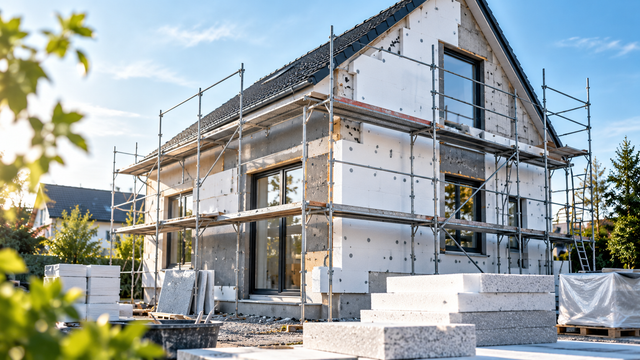
- Building envelope: insulation of facade, roof, top floor ceiling and basement ceiling as well as windows, external doors and sun protection
- Building systems other than heating: for example ventilation systems with heat recovery and digital systems for operational optimisation
- Heating optimisation: for example hydraulic balancing, replacement of old heating pumps and insulation of pipes
- Specialist planning and construction supervision by an energy efficiency expert
Owners, homeowners' associations and landlords are eligible to apply, as are tenants with the owner's consent. As a rule, the building must be at least five years old. The new guideline of 21 July 2026 replaces the previous version for individual measures from December 2023, but the basic principle of BEG funding for individual measures as a grant applied for before the project begins remains the same.
Funding rates and maximum limits since 21 July 2026
The basic funding for building envelope, building systems and heating optimisation to improve efficiency is 15 per cent of the eligible costs. With an individual renovation roadmap (iSFP), there is a bonus of 5 percentage points. New since 21 July 2026: this bonus only applies to the part of the eligible costs that exceeds 30,000 euros. For smaller projects, the effective rate therefore remains at 15 per cent.
Eligible costs are capped per residential unit and calendar year. For a detached house, the limit is 30,000 euros, or 60,000 euros with an iSFP. In apartment buildings, the limit is staggered: 30,000 euros for the first residential unit, 15,000 euros each for the second to sixth and 8,000 euros each from the seventh residential unit. For a detached house, this results in the following example values:
| Eligible costs | Grant without iSFP | Grant with iSFP |
|---|---|---|
| 20,000 euros | 3,000 euros | 3,000 euros |
| 40,000 euros | 4,500 euros (limit 30,000 euros) | 6,500 euros |
| 60,000 euros | 4,500 euros (limit 30,000 euros) | 10,500 euros |
The calculation shows that for larger projects, the iSFP mainly has an effect through the doubled maximum limit. Specialist planning and construction supervision are funded separately at 50 per cent, for detached and semi-detached houses for eligible costs of up to 5,000 euros, and for apartment buildings up to 2,000 euros per residential unit and no more than 20,000 euros in total.
Ventilation, heating, insulation: what exactly is funded

Ventilation systems
The installation of ventilation systems with heat recovery, central or decentralised, is funded provided they meet the minimum technical requirements of the funding guideline. The energy efficiency expert confirms these in the application. In addition to the unit, for example a central ventilation unit with heat recovery, air ducts, valves, installation and commissioning are usually also eligible. Our guide Planning Comfort Ventilation explains how a comfort ventilation system is planned.
Heating optimisation
For existing heating systems, BAFA funds measures that improve operation, such as hydraulic balancing, replacing old heating pumps, insulating pipes or installing low-temperature radiators. BAFA's information sheet sets out the requirements regarding the age and type of heating system. For certain biomass heating systems, there is also optimisation to reduce emissions at a higher funding rate. Our guide Hydraulic Balancing 2026 shows why hydraulic balancing is so important.
Insulation and windows
For insulation and windows, minimum values for heat transfer must be met, which the energy efficiency expert verifies. If more than a third of the windows are replaced, a ventilation concept must also be drawn up in accordance with DIN 1946-6. Window replacement and ventilation can therefore be planned well together.
Heating replacement: grant via KfW instead of BAFA
If you want to install a new heating system, such as a heat pump, you do not apply for funding from BAFA but from KfW. This heating subsidy is also part of the BEG, but has its own funding rates, bonuses and maximum limits, which were adjusted in July 2026. The basic funding is 30 per cent, and bonuses may be added depending on income and the starting situation. Our guide Heat Pump Funding 2026 provides an overview; KfW publishes the binding conditions. Ventilation and insulation under the BAFA programme and heating with KfW can be combined, as long as the same costs are not funded twice.
For 2027, KfW has already announced gradually decreasing funding rates and bonuses for heating, although the details differ between sources. If you are planning to replace your heating system, check the conditions directly with KfW and do not postpone the application unnecessarily.
BEG application for individual measures step by step

- Involve an energy efficiency expert: this is mandatory for measures on the building envelope and building systems, and the expert prepares the technical project description. You can find experts in the federal energy efficiency expert list.
- Obtain quotes and only conclude a supply or service contract with a condition that links it to the funding approval.
- Submit the application via BAFA's online portal before the project begins.
- Have the measure carried out once you have received the grant notice.
- After completion, submit proof of use with invoices, after which the grant is paid out.
The most common mistake is starting too early: anyone who awards contracts without a condition or has work started before the application is submitted loses their entitlement. Planning and consulting services may generally be provided beforehand. Please also note that a subsidised measure cannot additionally be claimed via the tax reduction for energy-related renovations or the tradesperson tax bonus.
The tax reduction under Section 35c of the Income Tax Act is an alternative for owner-occupied homes: it spreads a tax reduction of up to 20 per cent of the costs over three years and does not require an application before work begins, but it does require a certificate from the specialist company carrying out the work. Which route is more favourable depends on your tax burden and the costs. If in doubt, have this checked by a tax adviser.
Frequently asked questions
Is an iSFP still worthwhile for individual measures?
For small individual measures, the iSFP bonus has no longer brought a financial advantage since July 2026. For larger projects or several steps over the years, it is still worthwhile because the eligible costs are doubled. The roadmap also helps to coordinate measures sensibly.
Can tenants use BEG funding?
Yes, tenants can apply with the owner's written consent, for example for decentralised ventilation units in their own flat. The same rules apply as for owners.
When do I have to submit the BAFA application?
Always before the project begins, i.e. before you award a contract without a funding condition or start work. Allow a few weeks for this, because the energy efficiency expert first has to prepare the technical project description. If you want to renovate in spring, it is best to start planning now in autumn.
Is material for self-installation also funded?
As a rule, work carried out by specialist companies is funded. Material costs for self-installation may be eligible in some cases if a specialist company or the energy efficiency expert confirms professional installation. Clarify this before applying using the current information sheet.
Conclusion
The BEG funding for individual measures remains an important grant for insulation, windows, ventilation and heating optimisation in 2026. The basic funding is 15 per cent; since 21 July 2026, the iSFP bonus only applies above 30,000 euros, but it still doubles the eligible costs. The key factors are the right order of steps, an energy efficiency expert at your side and an application before the project begins. You apply separately to KfW for heating replacement. You will find ventilation units with heat recovery in our Ventilation Systems category, and matching heat pumps under Heat Pumps.