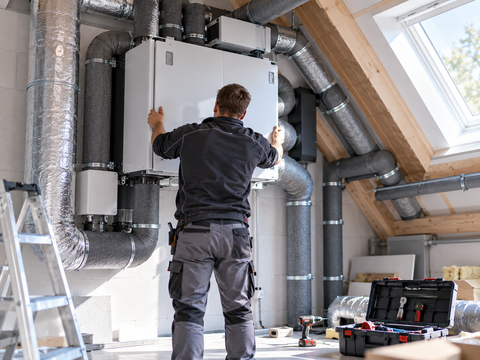
Cleaning a Ventilation System: DIY or Specialist?

A neglected ventilation system quickly turns into a bacteria spreader: dust, pollen and moisture accumulate in dirty filters and ducts, creating an ideal breeding ground for germs, which are then blown directly into your living spaces. At the same time, power consumption rises because the fan has to work against increased resistance, and heat recovery loses a noticeable amount of efficiency.
The good news: when cleaning your ventilation system, you can handle a considerable part of the work yourself, quickly, without special tools and without any risk to the unit. Other tasks, however, must be left to a specialist company. This guide shows you exactly where the line is drawn, what costs to expect and how to tell that your system urgently needs cleaning.
Cleaning your ventilation system yourself: filters and valves
You can handle two tasks without any expertise: changing the filters and cleaning the ventilation valves. Manufacturers deliberately design both so that laypeople can carry them out safely: the filters sit behind an easily accessible front cover, and the disc valves in the rooms can be removed with a simple twist. If you perform these two routines regularly, you have already covered most of the system's hygiene.
The filter is your system's first line of defense: it keeps dust and pollen out of the unit and the ducts. Once it is saturated, airflow drops, the fan works harder and, in the worst case, dirt bypasses the filter and enters the heat exchanger. Regular replacement is therefore the single most important measure of all, and it only takes a few minutes.
Over time, the disc valves in the kitchen, bathroom and living spaces collect dust and a film of grease, especially on the extract air side. This not only looks unsightly but also narrows the air passage. Important when reinserting: do not change the setting of the valve disc, because it sets the balanced airflow for that room.
Changing filters (5 minutes)
- Switch off the unit
- Open the front cover
- Old filter out, new filter in
- Note the arrow direction
- Press filter reset
Cleaning ventilation valves (10 minutes)
- Remove the disc valves
- Dust them with a microfiber cloth
- Wash them in the dishwasher
- Let them dry
- Reinsert and lock in place
Recommended frequency: filters every 3 to 12 months, valves every 6 months. Mandatory: use original filters! Cheap universal cut-to-size filters often do not fit exactly into the filter compartment. Unfiltered air then flows past at the edges, and the protection is lost. You will find suitable original replacement filters in our range. Our guide to Filter Classes for Ventilation Systems explains which class is right for you.
Work that only a professional should do
As soon as it comes to the inner workings of the system, DIY territory ends. The heat exchanger consists of very thin fins or plastic plates that can bend or break under even slight pressure. A damaged exchanger loses efficiency or stops being airtight altogether. The specialist company removes it, cleans it with suitable special cleaning agents and then checks it for leaks.
The difference is even clearer with the duct system: the ducts run for many meters through ceilings and walls and are simply not accessible without special equipment. Professionals use rotating brush machines with simultaneous vacuum extraction so that the loosened dirt does not get into the rooms, and they disinfect the ducts if necessary. The fan bearings and a genuine hygiene inspection with sampling also require experience and measuring equipment that a private household does not have.
| Component | What happens |
|---|---|
| Heat exchanger | Removal, cleaning with special cleaner and high pressure |
| Duct system | Brush machine, vacuum extraction, disinfection |
| Fan bearings | Bearing check, lubrication, belt replacement |
| Hygiene inspection | Sampling, microbiological analysis |
Tampering with these components yourself not only risks damage but, depending on the warranty terms, also disadvantages for any manufacturer's warranty. Our Maintenance Schedule for Ventilation Systems provides an overview of all intervals.
Cleaning costs at a glance
The running costs of a ventilation system are manageable, provided you split the work sensibly between DIY and a specialist company. The largest item in everyday operation is the replacement filters, which you change yourself. Professional work is needed far less often and can be planned well.
Important for putting this into perspective: in the end, a neglected system costs more than a well-maintained one. Dirty filters and exchangers drive up power consumption, reduce heat recovery and can cause consequential damage to the fan in the long run. Cleaning costs are therefore not just expenses; they secure the efficiency returns of your system.
- €50 to €100: filters per year
- €150 to €300: heat exchanger cleaning
- €500 to €1,500: duct cleaning (every 5 years)
Warning signs and the mandatory VDI 6022 standard
Your ventilation system lets you know when something is wrong. You just have to be able to read the signs. Many operators gradually get used to louder running noises or a slightly musty smell and only notice the problem once indoor air quality has suffered significantly. A deliberate check every few weeks costs nothing and saves expensive repairs later on.
A musty odor from the supply air valves should be taken particularly seriously: it indicates microbial growth in the unit or in the ducts, which is exactly what a ventilation system is supposed to prevent. Windows fogging up are also a classic sign that the system is no longer removing the moisture load.
Signs that cleaning is urgently needed
Act immediately if you notice a musty odor from supply air valves, dust marks around openings, higher power consumption or louder noises.
VDI 6022: what the standard requires
VDI 6022 sets binding hygiene requirements for commercial and public buildings, schools, hospitals and places of assembly. Operators of such systems must be able to prove regular inspections and hygiene checks. In the event of damage, the documentation becomes the decisive safeguard. For private households, too: many manufacturers make their warranty conditional on compliance with their maintenance recommendations, and the respective warranty terms apply. We carry suitable accessories and spare parts for maintenance in our shop.
Frequently asked questions
How often do I need to clean my ventilation system?
Filters every 3 to 12 months, the heat exchanger annually, the duct system every 5 to 8 years. The exact filter interval depends on the surroundings: on busy roads or in regions with high pollen levels, filters clog faster than in quiet locations.
Can I clean the heat exchanger myself?
Not recommended: the fins can be damaged. This should only be done by a professional using special cleaner and compressed air. A damaged exchanger usually costs significantly more than professional cleaning.
How much does professional cleaning cost?
Heat exchanger €150 to €300, duct system €500 to €1,500, fan service €100 to €250.
How can I tell that cleaning is needed?
Musty odor, dust marks, higher power consumption, louder noises or windows that fog up again. If several signs occur at the same time, you should hire a specialist company promptly.
Conclusion
Caring for a ventilation system is not rocket science if you know who is responsible for what: you can change filters and clean valves yourself in a few minutes; the heat exchanger, duct system and hygiene inspection belong in professional hands. If you consistently take care of both areas, you ensure clean indoor air and low operating costs and meet the maintenance requirements to which many manufacturers tie their warranty. Do not wait for the warning signs; establish fixed routines instead. Your system will reward you with many years of reliable operation. If you are planning a new system, you will find all the basics in the guide Planning MVHR. Everything related to residential ventilation is available in the ventilation range at wohnungstechnik.de.