Window Ventilation vs. Ventilation System: An Honest Comparison

Fogged-up windows, musty air in the bedroom and, in the worst case, dark mold stains in the corner: if you are wondering whether window airing or a ventilation system is the better choice, these are often exactly the problems you have in mind. Modern, well-insulated houses are almost airtight, and without targeted air exchange, stale, humid air simply stays in the room.
In this guide, we compare both approaches honestly and without a sales pitch: how well does classic window ventilation really protect against moisture, how much heating energy does it cost, and when is a controlled ventilation system with heat recovery worthwhile? You will find out which solution suits your building, your daily routine and your budget.
Why proper ventilation is essential
In a four-person household, around 8 to 12 liters of water enter the indoor air every day just from breathing, cooking, showering and drying laundry. This moisture must be reliably removed to the outside; otherwise, it condenses on cold building components such as window reveals or exterior walls. The consequence is well known: if the humidity is permanently too high, mold develops, damaging both the building fabric and your health.
As a rule of thumb, a relative humidity of 40 to 60 percent is considered healthy and comfortable. Besides moisture, stale air is also an issue: when CO2 levels rise, concentration and sleep quality suffer. Regular air exchange is therefore not a comfort luxury but protection for the building and your health at the same time. You can read which values make sense in your rooms in our guide to optimal humidity in the home.
Window ventilation: advantages and limitations
Window ventilation is the simplest and cheapest method: it costs nothing to purchase and works everywhere. Done correctly, this means burst airing, i.e., opening the windows wide for a few minutes several times a day, ideally across the whole apartment. Permanently tilted windows, by contrast, are inefficient and mainly cool down the window reveals, which can even encourage mold.
The limitations become apparent in everyday life. First, window ventilation is completely dependent on the occupants: anyone who works during the day or is traveling cannot air regularly, and that is precisely when moisture builds up. Second, valuable heating energy is lost in winter. Studies by the German Environment Agency (Umweltbundesamt) show that in well-insulated buildings, up to 30 percent of the heating energy can be lost through window ventilation. Third, opening the windows also lets pollen, dust, noise and insects into the house.
If you air through the window, a simple rule of thumb helps: in winter, with a large temperature difference, around 5 minutes of burst airing is often enough; in fall and spring about 10 to 15 minutes; in summer more like 20 to 30 minutes. Cross-ventilation with windows on opposite sides is most effective because the air is then completely replaced in a short time. You should air humid rooms such as the bathroom and kitchen immediately after showering or cooking so that the moisture does not spread to other rooms in the first place.
Ventilation system with heat recovery
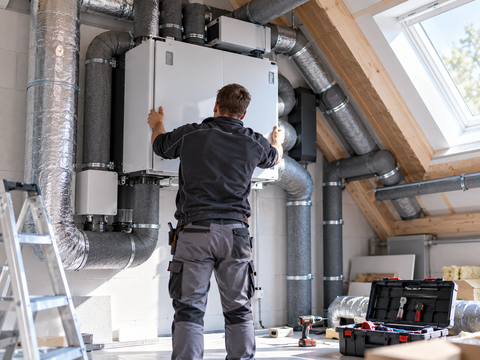
Controlled residential ventilation takes care of air exchange automatically and around the clock. The key feature is heat recovery: a heat exchanger transfers the heat from the exhaust air to the fresh supply air without the two air streams mixing. Central systems achieve efficiencies of up to 90 to 95 percent, while decentralized single-room units usually reach 60 to 75 percent. The minimum standard eligible for funding is around 80 percent.
Further advantages: integrated filters retain pollen and fine particulates, which provides noticeable relief for allergy sufferers. The system works independently of the occupants and, according to DIN 1946-6, can be operated in four levels, from permanent moisture protection during absence to intensive ventilation while cooking. We explain in detail whether a central or decentralized solution is the better fit in Central vs. decentralized ventilation and in our guide to planning a comfort ventilation system.
Window ventilation and ventilation system compared directly
The following overview summarizes the most important differences:
| Criterion | Window ventilation | Ventilation system with HR |
|---|---|---|
| Purchase | none | decentralized from approx. 300 euros per room, central around 8,000 to 15,000 euros |
| Heat loss | high, up to 30 percent | low, HR up to 95 percent |
| Moisture protection | only with consistent airing | permanent and independent of occupants |
| Pollen and dust | enter unfiltered | are filtered |
| Everyday effort | airing several times a day | runs automatically |
| Maintenance | none | regular filter changes |
What makes sense for your home?
For many existing apartments, window ventilation remains a practical solution, provided you air consistently and the rooms are not permanently damp. However, as soon as you build new or carry out a comprehensive renovation, DIN 1946-6 comes into play: it requires a ventilation concept if more than one third of the windows are replaced or more than one third of the roof area is insulated. Moisture protection must then be ensured even without active involvement by the occupants, and that is exactly what a ventilation system delivers.
In practice, by the way, the two approaches are not mutually exclusive. Many households do well using a ventilation system for continuous basic air exchange and also opening the windows in nice weather whenever they feel like it. This combines the permanent moisture protection of the technology with the good feeling of fresh outdoor air.
It is also worth taking a second look at the budget. In 2026, systems with a heat recovery rate of 80 percent or more qualify for a 15 percent grant through the federal BEG funding program, or even up to 20 percent with an individual renovation roadmap. You can find the right units, ducts and filters in our categories Ventilation systems, Ventilation and Air filters.
Frequently asked questions
Does a ventilation system completely replace airing through windows?
Technically yes: a correctly designed system permanently ensures the necessary air exchange. Many people still open the windows occasionally; this remains possible and does no harm. However, it is no longer strictly necessary for moisture protection.
Does a ventilation system dry out the indoor air too much?
In winter, the air can feel drier because cold outdoor air naturally contains little moisture. Modern units counter this with a moisture recovery heat exchanger, the so-called enthalpy exchanger, which retains some of the moisture and makes the indoor climate more pleasant.
How often do I need to change the filters?
Depending on location and pollen load, you should check the filters about every three to six months and replace them if necessary. Clean filters are essential for air quality and system efficiency.
Is a ventilation system also worthwhile in an older building?
Yes, especially after an energy-efficient renovation. Decentralized units can often be retrofitted with manageable effort and significantly improve moisture protection and air quality without complex duct networks throughout the house.
Conclusion
Whether window airing or a ventilation system is the right choice depends mainly on the building and your daily routine. Window ventilation is free and flexible but requires discipline and costs a lot of heating energy in winter. A ventilation system with heat recovery ensures permanently good air, protects against mold and saves energy in the long term, albeit at higher purchase costs. For new builds and renovations, there is hardly any way around a ventilation concept anyway. You will find suitable ventilation units, accessories and filters directly in our shop under Ventilation.