CO2 Indoors: When Does the Air Become Unhealthy?

We cannot see carbon dioxide and we cannot smell it, and yet the CO2 level of indoor air plays a daily role in how focused, alert and comfortable we feel within our own four walls. Especially in well-insulated, airtight apartments, the concentration in closed rooms rises faster than most people expect: in the bedroom overnight or in the home office after a few hours at the desk. That is exactly why it is worth taking a look at the CO2 limit values for indoor air: they tell you when the air is merely stale and when it actually becomes unhealthy.
In this guide, we explain which ppm values are considered harmless, elevated and unacceptable, which symptoms occur as the concentration rises, how to measure the CO2 level reliably and which measures lower it for good. This allows you to assess the air quality in your home objectively instead of relying on gut feeling. In short, for the CO2 level in your home: below 1,000 ppm the air is good, from 2,000 ppm it is clearly too stale.
Why CO2 levels rise indoors
In living spaces, carbon dioxide is mainly produced by ourselves: every person exhales it continuously. In open outdoor air, the concentration is currently around 420 ppm (parts per million). As soon as several people are in a closed room, the air becomes enriched, and depending on room size, number of people and ventilation, the value climbs significantly within one to two hours.
Modern construction makes matters worse. Airtight windows and good thermal insulation save heating costs but also prevent the uncontrolled air exchange through gaps that older buildings had naturally. Without deliberate airing or mechanical ventilation, the stale air remains in the room. CO2 is an ideal indicator here: when it rises, humidity, odors and other emissions usually rise too. If you have the CO2 level under control, you usually have overall air quality under control.
CO2 limit values for indoor air: the key figures
The best-known reference value goes back to the chemist Max von Pettenkofer, who back in the 19th century described the limit of 1,000 ppm as the threshold for good indoor air. This so-called Pettenkofer number is still considered a rule of thumb today. The German Environment Agency (Umweltbundesamt) has turned it into a more differentiated assessment that has become established in Germany:
| CO2 concentration | Assessment | Recommendation |
|---|---|---|
| up to 1,000 ppm | hygienically harmless | good air quality, no action needed |
| 1,000 to 2,000 ppm | hygienically elevated | ventilate, increase air exchange |
| over 2,000 ppm | hygienically unacceptable | ventilate immediately and intensively |
For rooms used for focused work or sleeping, i.e., offices, classrooms and bedrooms, an average of around 1,000 ppm is the target. In 2024, the Austrian Indoor Air Working Group even recommended a more ambitious target value of 800 ppm for rooms with permanent occupancy. As a rough rule to remember: everything below 1,000 ppm is good, from 1,000 ppm you should act, and from 2,000 ppm the air is clearly too stale.
When does the air become unhealthy? Symptoms by CO2 level
The limit values are not arbitrary numbers; they reflect how our body reacts. Up to about 1,000 ppm, most people feel fresh and productive. Between 1,000 and 1,400 ppm, the first noticeable effects often appear: concentration declines, you tire more quickly and attention drops, often without those affected noticing the cause.
If the value rises above 1,400 ppm, many people also experience headaches, drowsiness and a marked decline in mental performance. Studies show that typical thinking and decision-making tasks become measurably more difficult at high CO2 concentrations. Beyond 2,000 ppm, the air is considered unacceptable: here, lethargy and concentration problems are the rule. It is important to put this into perspective: in normal living spaces, no acutely life-threatening levels are reached; it is about well-being, sleep quality and performance, not an immediate risk of poisoning. However, it is precisely these gradual effects that make good air exchange so valuable.
Measuring CO2: how to keep an eye on indoor air
Since CO2 cannot be perceived, a measuring device is the only reliable way to know the actual value. Good CO2 traffic light monitors and sensors work with an NDIR sensor (non-dispersive infrared measurement) and display the ppm value either as a number or as a simple traffic light system: green means good air, yellow means ventilate, red signals an urgent need for action.
Measuring is particularly useful where you spend a lot of time: in the home office, in the bedroom and in children's rooms. When buying, look for a genuine NDIR sensor, because many cheap devices only estimate the CO2 value from other measured variables and deliver inaccurate results. A well-placed device at head height, not directly next to a window or door, quickly shows how much the concentration fluctuates over the course of the day, and gives you the perfect reason to provide fresh air in good time.
Lowering CO2 for good: correct ventilation and mechanical solutions
The fastest measure is consistent burst ventilation: open the windows wide for a few minutes, ideally with a cross draft, so that the stale air is completely replaced with fresh air. Tilted windows, by contrast, provide hardly any air exchange and only cool down the walls in winter. As a rule of thumb: in occupied rooms, use burst ventilation several times a day; in the bedroom, before going to bed and right after getting up in the morning.
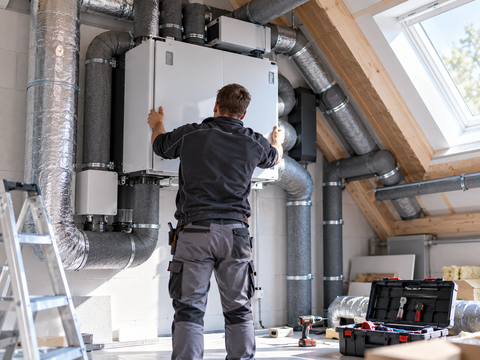
If you do not want to control the CO2 level by hand all the time, rely on a mechanical solution. A ventilation system with heat recovery exchanges the air continuously and automatically without losing heating energy, and modern units even control their output based on CO2. Decentralized units are suitable for individual rooms, a centralized system for the whole apartment. Air purifiers complement this by reducing particles and odors, but they do not lower the CO2 level itself; that always requires genuine air exchange. You will find a suitable selection of devices and accessories in our Ventilation category. You can also read how to achieve a healthy indoor climate overall in our guide Healthy Indoor Climate, and the article on optimal humidity shows how to keep moisture under control.
Frequently asked questions
What CO2 level is still acceptable in the bedroom?
For restful sleep, the CO2 level should ideally stay below 1,000 ppm. In closed bedrooms, this value is often exceeded overnight. Therefore, air the room vigorously shortly before going to bed or ensure continuous air exchange with a ventilation system.
Is CO2 in the apartment dangerous?
In normal living spaces, no acutely toxic concentrations occur. However, elevated levels above 1,000 to 2,000 ppm lead to fatigue, headaches and poor concentration. So it is about well-being and performance, not an immediate risk of poisoning.
How fast does the CO2 level rise in a room?
That depends on room size, number of people and ventilation. In a small, closed office with two people, the value can exceed the 1,000 ppm mark after just one to two hours. Regular burst ventilation or automatic ventilation keeps it low permanently.
Does an air purifier lower the CO2 level?
No. Air purifiers filter particles, pollen and in some cases odors, but do not remove CO2 from the air. To lower the CO2 level, genuine air exchange is always necessary, either by airing or through a ventilation system.
Conclusion
The CO2 level is the simplest and most meaningful indicator of good indoor air. As a guide: up to 1,000 ppm is harmless, between 1,000 and 2,000 ppm is elevated and calls for ventilation, and above 2,000 ppm is unacceptable. If you know these values and keep an eye on them with a measuring device, you will immediately recognize when fresh air is needed. Consistent burst ventilation solves the problem in the short term; for permanent, convenient results, a ventilation system with heat recovery ensures consistently good air. You will find suitable ventilation units, sensors and accessories for a healthy indoor climate in the Wohnungstechnik.de range.